


Part 2- Have You Had a Painful Summer?
August 13, 2026
Read More

If you genuinely forgive someone who sinned against you:
Simply read the narratives about our Savior.
For example, when a paralytic was lowered through the roof to receive healing, there’s no indication he sought forgiveness, yet Jesus declared, “Your sins are forgiven.”
When a woman of ill repute anointed Jesus’ feet and wiped them with her hair, we have no record of her formally asking, “Forgive me.” But once again, Jesus responded, “Your sins have been forgiven.”

Now that’s laughable. Do you ask God to forgive you, like all the time, but within minutes you go out and commit the exact same offense again? You must be glad that’s not God’s standard with you.
Father, forgive them; for they do not know what they are doing. - Jesus

My goodness. Is a merit-based pardon a pardon at all?
In the 1700’s, British Pastor & Evangelist John Wesley was traveling with Gen. James Oglethorpe, who was angry with one of subordinates.
A man came, humbly asking for forgiveness, and gruffly exclaimed, “I never forgive!”
Wesley, one who walked a straight walk and talked a straight talk, took the General by the coat, looked him in the eyes, and said, “Then I pray dear sir, that you may never sin.”
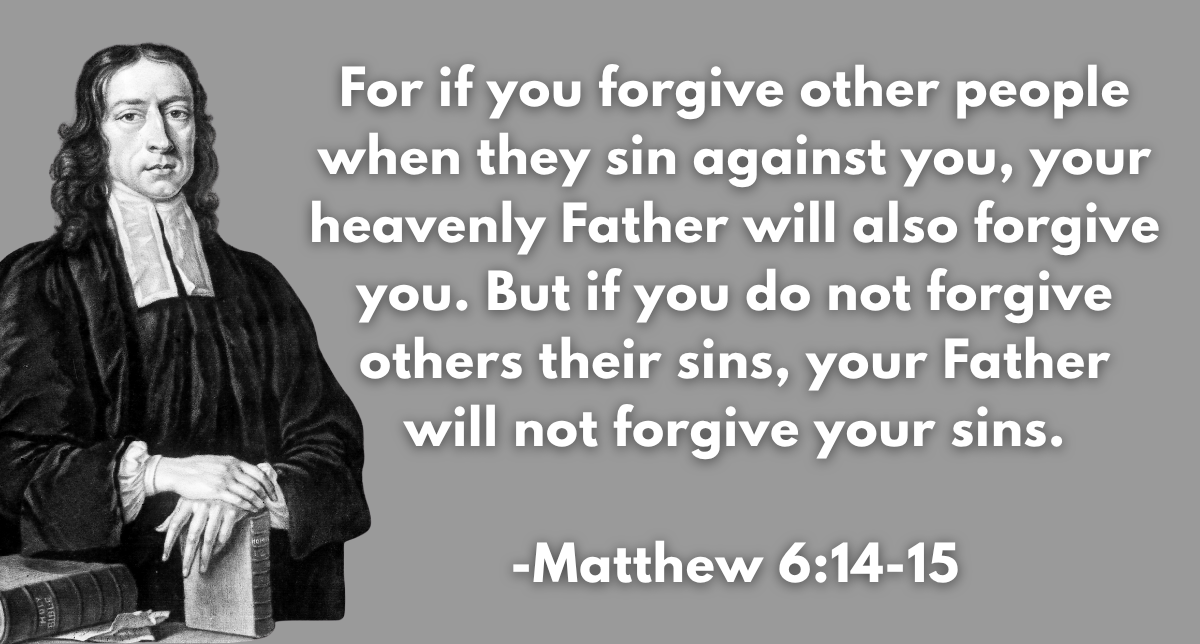
At some point, you’ve got to address the comparative conjunction “as.” It’s a two-letter word that makes all the difference.
Almost every one of you has offered up hundreds of prayers that hinge on that little word. Whether you’re religious or irreligious, raised in church or not, I’m pretty certain you haven’t noticed the “as” in a long time.
I’m referring to The Lord’s Prayer, in particular, the basis upon which you ask God to forgive your debts. Go ahead, fill in the blanks.
Other versions say:
In other words, “to the degree I’m willing to forgive others, Lord, let that be the standard by which you forgive me.”
*Please note that I have never minimized the wrongdoing committed against you, nor have I downplayed its ravaging effects. The open wounds you’ve suffered are very real. What I am saying is this- In the New Testament, forgiveness (Greek aphiēmi) means to send away, release. You must release the offender; otherwise, they will still occupy space in your head, and they don’t belong there.

Jesus told a parable that speaks to this very issue. A servant owed his king 10,000 talents, which amounts to a modern-day equivalent of 60 million days of wages (9 billion dollars). Just the interest alone at 5% would be 450 million a year.
Shockingly, out of extreme graciousness, the king cancels the debt. Yet immediately, the servant turns around and demands every cent from a man who owes him 100 denarii ($20,000 today).
That’s messed up.
Practically, do you want the person who hurt you to continue exerting influence or power over you?
I doubt it. If you cling to the pouch of bitterness, although they have either died or moved on, you lose.
Don’t wait, go ahead and release them to the Lord, and let Him deal with each as He may.
Here’s the thing. If you don’t want to forgive someone, or find it impossible to do so, how about this? Would you at least be willing to plead with the Holy Spirit to implant a desire to forgive deep in your soul? No shame- that’s a good place to start.
If you’re tempted to forward this blog to someone who you think needs it, please don’t. This blog wasn’t intended for them; it’s intended for you.
Free: Chapter 1 of The Four Faces of Christ (PDF) · Get new articles by email every Thursday


