


Why Inerrancy is Essential in our "Cafeteria" Culture
May 28, 2026
Read More
The thousands of ancient manuscripts we have in hand actually work in our favor. We can compare them, spot where copyists differed, and know with remarkable certainty that the Bible we have today accurately reflects what the original writers wrote.
In an ancient monastery, a new monk arrived to join the others copying old manuscripts by hand. He quickly noticed they were copying from copies that had already been copied by hand.
Finally, he spoke up.
“Forgive me, Father Justinian, but how do we know we aren’t copying someone else’s mistakes? Are these ever checked against the originals?”
Father Justinian paused. No one had ever suggested that before.
“That is a good point, my son. I’ll take one of these down to the vault and compare it with the original.”
He disappeared deep into the monastery vault.
The day passed, then evening came, and the monks began to worry. Finally, one of them went looking for him. As he made his way through the old vault, he heard sobbing.
“Father Justinian?”
The sobbing grew louder. At last he found the old priest sitting at a table with the new copy and the ancient original in front of him. He had clearly been crying for some time.
“What is the matter?” the monk asked.
Father Justinian looked up through his tears.
“The word isn’t ‘celibate’…”
The monk looked confused.
“What is it then?”
“Celebrate.”
Funny story.
But Father Justinian actually raises a pretty good question about the Bible. For hundreds of years, Scripture was copied by hand. And copied again. And copied again.
So how do we know somebody didn’t leave out a word, add a word, misspell something, or simply make a mistake somewhere along the way?
In other words, can we trust the Bible we have today?
The first thing we need to clear up is something Christians sometimes misunderstand about inerrancy. Biblical inerrancy means the Bible, as originally written, was without error. The apostles and prophets wrote under the inspiration of the Holy Spirit. As Peter put it, men “spoke from God as they were carried along by the Holy Spirit” (2 Peter 1:21).
That promise does not extend to every ancient scribe who picked up a pen. Copyists could make mistakes. And occasionally they did.
The question is whether those mistakes prevent us from knowing what the original Bible actually said.
And that’s where things get interesting.
We possess more than 5,800 Greek New Testament manuscripts, many of them fragments, and together they preserve the original text. By comparing those manuscripts with one another, scholars can reconstruct the original text with more than 99 percent accuracy.
Think about it this way. Suppose the original United States Constitution disappeared tomorrow. Would we suddenly have no idea what it said?
Of course not.
There are enough copies scattered everywhere that we could reconstruct the original. Even if one copy accidentally left out a word and another misspelled one, comparison would expose the errors. The same principle applies to Scripture.
Ironically, having so many copies is not a weakness. It is one of our greatest advantages because we can check the copies against each other.
Now, does that mean scholars agree about every letter of every manuscript? No. There are places in your Bible where a footnote might say, “Some manuscripts read…such and such.” I’m glad those notes are there. We shouldn’t hide them.
But no major Christian doctrine hangs on one of those disputed words. We haven’t suddenly discovered a manuscript saying Jesus wasn’t resurrected on the third day. We haven’t discovered one where John 3:16 reads, “whoever believes in Him might not perish and might have everlasting life.”
And all of this brings us back to an amazing truth:
God wrote directly to us!
The Lord used human authors—more than 40 of them, writing in different places, different languages, and across roughly 1,500 years. Their personalities and writing styles remained their own, while the Holy Spirit guided the entire process so that what God intended to say was said.
And what does God say about what He gave us?
“Your word is truth.” —John 17:17
“The Law of the Lord is perfect.” —Psalm 19:7
“Every word of God is flawless.” —Proverbs 30:5
“All Scripture is inspired by God.” —2 Timothy 3:16
This is why I have such a hard time with cafeteria Christianity—the idea that we can walk through the Bible picking what looks appetizing and leaving the rest behind.
Thomas Jefferson actually tried it. He took a razor and glue and constructed his own version of the New Testament, cutting out the supernatural portions he didn’t believe. Feeding the 5,000? Gone. Walking on water? Gone. Miracles? Gone.
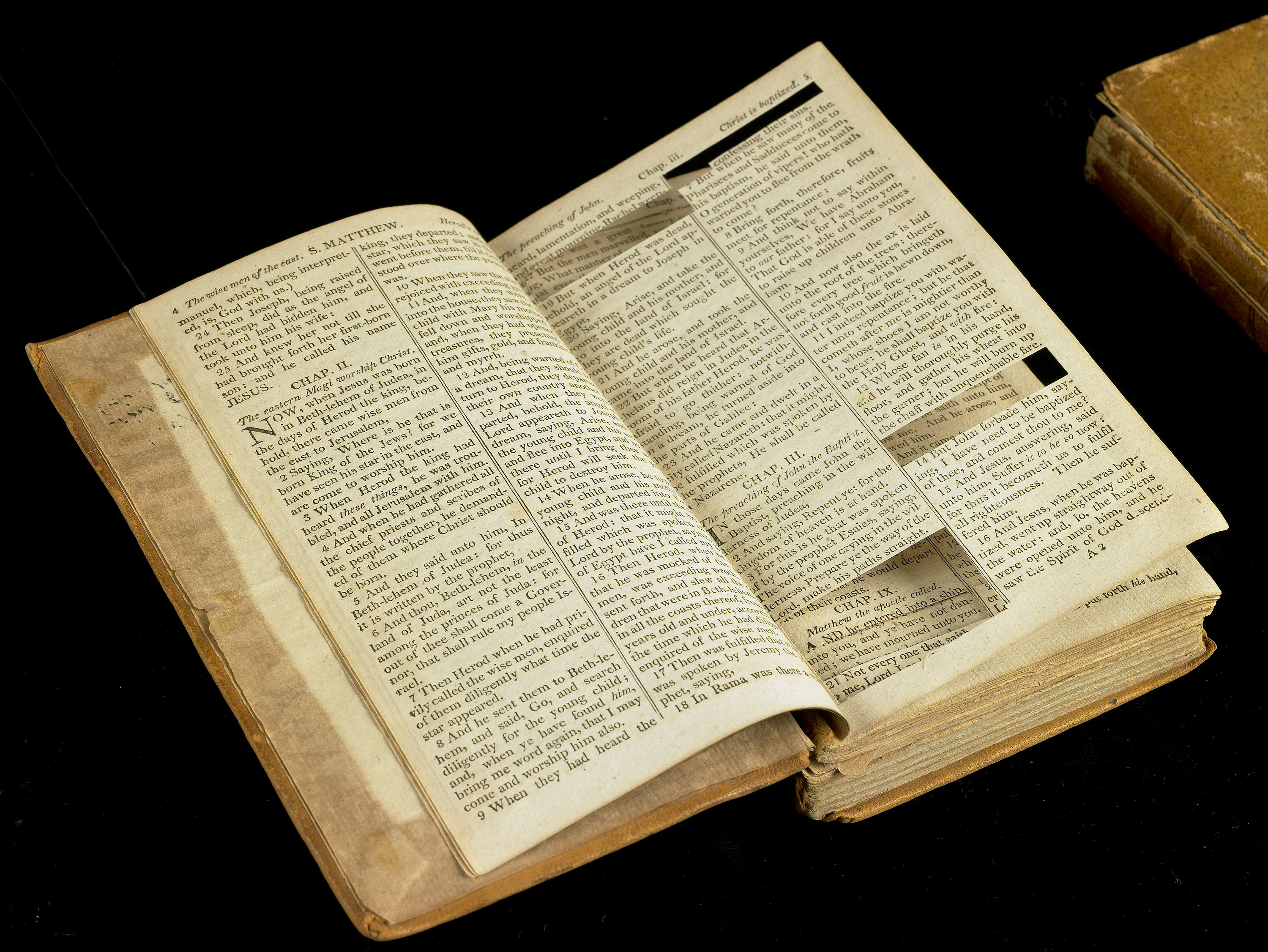
At least Jefferson was honest about what he was doing.
Today we tend to use a figurative razor:
“This part I like.”
“This part makes me uncomfortable.”
“That sounds outdated.”
“I’m not sure God really meant that.”
But once we decide that part of God’s Word can’t be trusted, we have another problem:
Who gets to decide which part?
I’ve yet to hear a satisfactory answer.
Jesus certainly didn’t approach Scripture that way. He said, “Man shall not live on bread alone, but on every word that proceeds out of the mouth of God” (Matthew 4:4). He never divided His teaching into nice, neat categories that allowed us to pick and choose according to how we feel.
That leaves us with a pretty simple equation:
God cannot err.
The Bible is the Word of God.
Therefore, the Bible cannot err.
Father Justinian’s epiphany makes for a pretty funny story. But when it comes to Scripture, the stakes are much higher.
If God has spoken, we had better know what He said. And we do. Now that is something worth celebrating.


