


What Did Jesus Look Like
October 1, 2026
Read More

In first-century Palestine, the only people carrying crosses were people walking to their own execution.
Every single person who heard Jesus say it understood that immediately. A man with a crossbeam on his shoulder was a dead man on his way to the site.
So when Jesus said, "Take up your cross and follow Me," He was not describing an inconvenience, a nagging health problem, a difficult in-law, or a burden you learn to live with. He was asking whether you are willing to die — and in the meantime, whether you're willing to die to yourself.
Here is the verse in full:
"If anyone wishes to come after Me, he must deny himself, and take up his cross and follow Me. For whoever wishes to save his life will lose it, but whoever loses his life for My sake and the gospel's will save it" (Mk. 8:34-35).
Crosses adorn everything now. Too much, if you ask me.
They've become fashionable for the religious and irreligious alike, with no discernible divide left between the sacred and the secular. They're printed on t-shirts, worn casually. They hang as decorative accents in living rooms. Odds are decent you're wearing one right now.
What once evoked horror and extreme sorrow hardly earns a second glance.
We've grown so accustomed to the presence of crosses that the shock value has drained out of them entirely.
What if I told you that you know the Hebrew word Israelites used for whole burnt offerings? It's holocaust. Now I have your attention.
What Christ underwent at Calvary was, in every sense of the term, a holocaust.
Try substituting that word from time to time — take up your holocaust and follow Me — and see whether the horror comes back into it. Because that's the way Jesus was speaking.
The prophet Jeremiah asked it this way: "Is it nothing to you, all who pass by?" (Lam. 1:12).
Mark doesn't state the implication outright, but it lingers over his whole Gospel, and it gets heavier the closer he walks you to Jerusalem.
Think about the pattern he lays down.
John the Baptist, the most remarkable man who ever lived, by Jesus' own assessment, had his head presented to King Herod on a platter.
God's own Son endured betrayals, false accusations, whippings, mock trials, and executioners.
Then follow the logic to its conclusion. If our mission is a continuation of His mission, what exactly do we suppose happens to us?
When Jesus extended His hand and said, "Go into all the world and preach the gospel to all creation," did the scars on His palms register with the disciples standing there?
Should we assume His scars become our scars?
Mark also records Jesus saying something that ought to stop you cold. In Mark 13:11, He did not say if they arrest you and hand you over. He said when they arrest you and hand you over.
Dietrich Bonhoeffer put it in five words: "When Christ calls a man, He bids him come and die."
I'm convinced Mark is giving us a heads-up about what we're signing up for. No fine print. No legal disclaimers. Discipleship comes with a price tag and a cost.
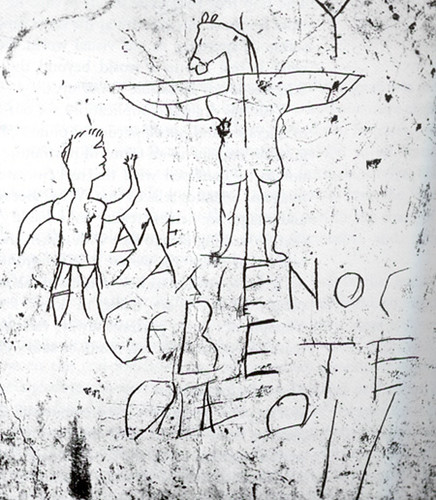
There's a piece of first-century graffiti carved into plaster on a wall in Rome that tells you exactly how this looked from the outside.
It depicts a man gazing at a donkey-headed figure being crucified. The inscription reads, "Alexandro worshiping his god."
It wasn't a tribute. It was mockery — scratched out to make fun of a Christian named Alexandros by implying he worshiped a donkey-headed god. And the fact that his god is shown crucified made the insult worse, since crucifixion was reserved for the most serious criminals.
That's what following Jesus bought you in the first century. Suspicion, contempt, and your faith turned into a joke on a wall.
Nobody in that world took up a cross for the social benefits.
For some believers throughout history, yes. For most of us, the daily version comes first, and Jesus described it in the same breath.
Look at the sequence in Mark 8:34. Three verbs, in order:
Deny himself. Before there's a cross to carry, there's a self to set down.
Take up his cross. Accept the cost in advance, whatever it turns out to be.
Follow Me. Not admire. Not agree with. Follow — meaning go where He went, which was toward Jerusalem and not away from it.
Then comes the paradox in verse 35: whoever wants to save his life will lose it, and whoever loses his life for Christ's sake will save it.
That's the arithmetic of the Christian life. Grip your life tightly, and it slips through your fingers. Hand it over, and it comes back to you.
And notice what Jesus never does here. He doesn't undersell it. He doesn't promise you'll come out ahead in this life. He states the cost plainly and then invites you anyway.
Mark's Gospel sprints. Immediately appears forty-one times, and in the Greek nearly every chapter opens with and, chaining events so you can't stop for breath.
Then at Mark 10:32 everything slows to a molasses crawl. You catch your breath resting off the brow of a hill, looking down at Jerusalem from the east.
From there, he walks slower and talks slower and points out details between every step. Roughly 40% of his Gospel covers the final week — ten chapters for thirty-three years, six and a half for seven days.
And there's one thing he refuses to let you miss. It's as if he's pleading: whatever it takes, I will not allow you to miss that middle cross.
He partitions you off at a distance — close enough to observe every bit of it, too far away to change the outcome. The sight, the sound, the smell, the sheer weight of atoning death, held at the exact midpoint between your senses and your imagination.
But once you've stood there, something is left unresolved, and Mark means for it to nag at you.
Could there be a lesser cross with your initials on it, waiting somewhere back in the shadows?
I don't think Mark ever intended to answer "what does it mean to take up your cross" in a tidy sentence you could underline and move past.
I think he wanted you to close his Gospel asking a different question altogether:
What price am I willing to pay?
That's a far more uncomfortable place to land, and it's the honest one. Because the answer isn't theoretical. It gets settled in ordinary weeks, in what you're willing to be embarrassed about, who you're willing to be associated with, and what you'll give up before anyone forces the issue.
Remember the verse that best summarizes Mark's entire account, and notice it's about a cost too: "For even the Son of Man did not come to be served, but to serve, and to give His life as a ransom for many" (Mk. 10:45).
He paid first. He's simply asking whether we understood the terms.
Here's a concrete way to feel the weight of this rather than just think about it.
Get uncomfortable. Deliberately put yourself somewhere you'll engage with people who don't believe any of it.
Go to a secular book club. Have dinner with unbelieving coworkers after work. Sit down with the family member you've been avoiding on this subject.
You'll learn more about what it costs to follow Christ in one awkward evening than in a month of reading about it.
And the next time you pass a cross hanging on a wall or resting against someone's collarbone, let it stop you dead in your tracks for a second.
"Is it nothing to you, all who pass by?"
What does "take up your cross" actually mean?
It means accepting the full cost of following Jesus, up to and including death. In first-century Palestine the only people carrying crosses were condemned criminals walking to their own executions, so the phrase carried no ambiguity for anyone who heard it.
Is my illness or hardship the "cross" Jesus was talking about?
That's the common modern reading, but it isn't what the phrase meant. Jesus paired it with denying yourself and losing your life for His sake — a voluntary surrender, not an involuntary burden. Hardship is real, and God uses it, but it isn't what Mark 8:34 is describing.
Where does Jesus say "take up your cross"?
Mark 8:34-35, with parallels in Matthew and Luke. Mark's version sits in the middle of a Gospel that devotes roughly forty percent of its length to Jesus' final week and death.


