


Why Is the Gospel of John So Different from Matthew, Mark, and Luke?
September 17, 2026
Read More

There is not a single historical reference that tells us what Jesus looked like. Not one. The New Testament authors, who had every opportunity, stayed almost completely silent on the subject — offering only a rare mention, mostly in passing.
The earliest Christians knew no more about His appearance than you and I do.
And the one description Scripture does give runs directly against every painting you've ever seen of Him:
"He has no stately form or majesty that we should look upon Him, nor appearance that we should be attracted to Him." (Isaiah 53:2)
But here is the part most people never consider. That silence is not an accident or an oversight. It's deliberate. His face simply is not the part of Jesus that Matthew, Mark, Luke, and John want you looking at.
Think about the opportunity these four men had and passed up.
They either walked with Him daily or interviewed the people who did. They record what He ate, where He slept, who He touched, what He said under His breath, and how He sounded when He wept. Matthew tells us the specific coin in a fish's mouth. Mark tells us Jesus was asleep on a cushion in the stern of the boat. Luke tells us what Mary was pondering in her heart.
These are not men who lacked an eye for detail.
And every one of them declines to describe His face.
Four separate authors, writing decades apart, for four different audiences, in three different countries — and not one of them thought to mention the hair, the height, the build, the eyes. That is not four men forgetting. That is four men agreeing.
So the honest question isn't "Why don't we know what Jesus looked like?" It's "What were they pointing at instead?"
Because they were absolutely pointing at something. Although Matthew, Mark, Luke, and John never sketch His physical appearance, there is very specifically something each of them intends for you to perceive. They withheld the one thing your eyes would have grabbed first, so that you'd have to look at what actually mattered.
That's not a gap in the record. That's the design of it.
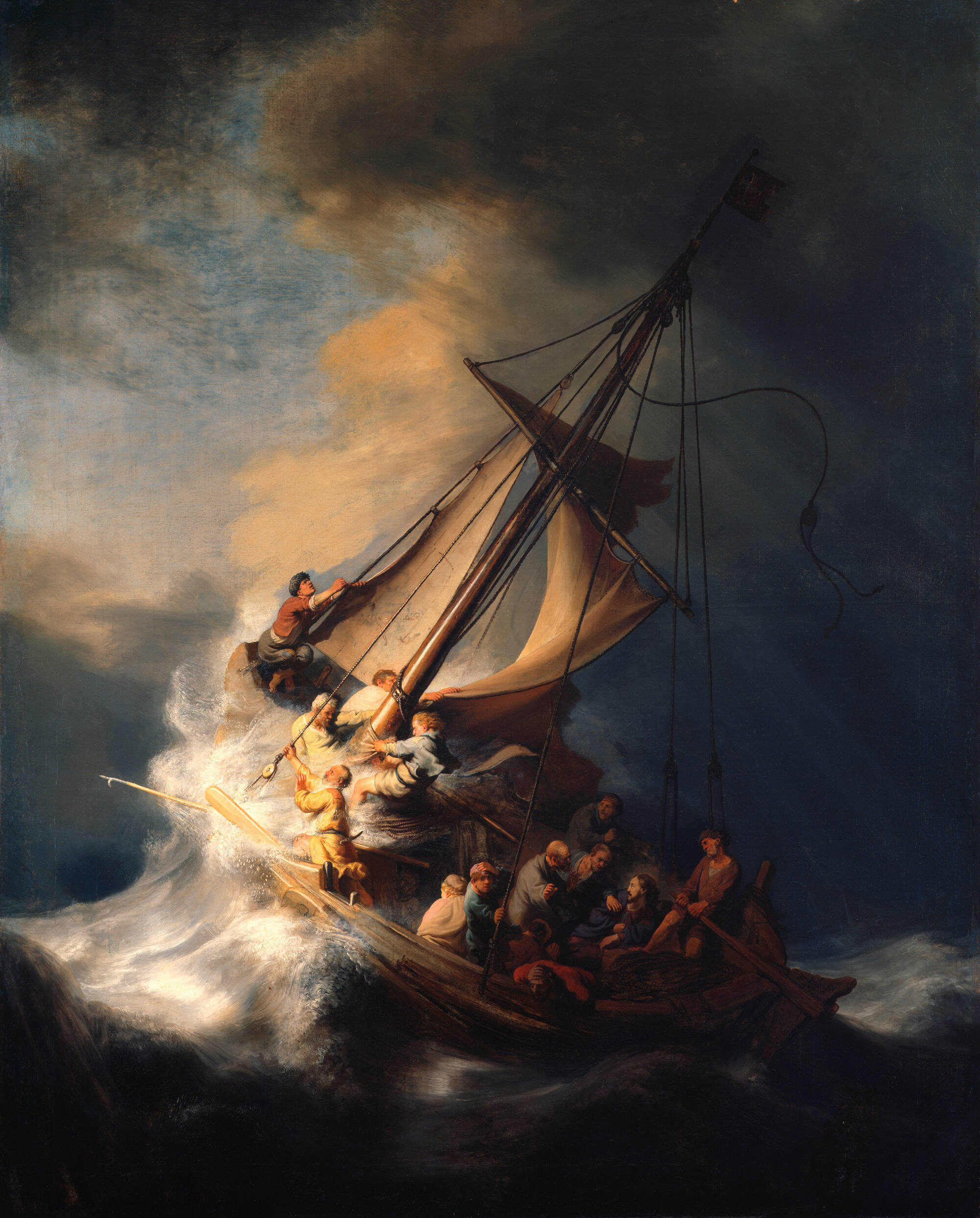
Isaiah gives us three passages, and none of them flatter.
Isaiah 53:2 — "no beauty or majesty to attract us to him, nothing in his appearance that we should desire him"
Isaiah 53:3-4 — "like one from whom men hide their face He was despised, and we did not esteem Him. Surely our griefs He Himself bore, and our sorrows He carried; yet we ourselves esteemed Him stricken, smitten of God, and afflicted"
Isaiah 52:14 — "his appearance was so marred, beyond human semblance, and his form beyond that of the children of mankind"Now stand those next to the murals and the stained glass. Wavy brown hair. Royal blue eyes. An inviting demeanor. A face designed to make you comfortable.That's not what Isaiah described, and it isn't what the people around Him saw.
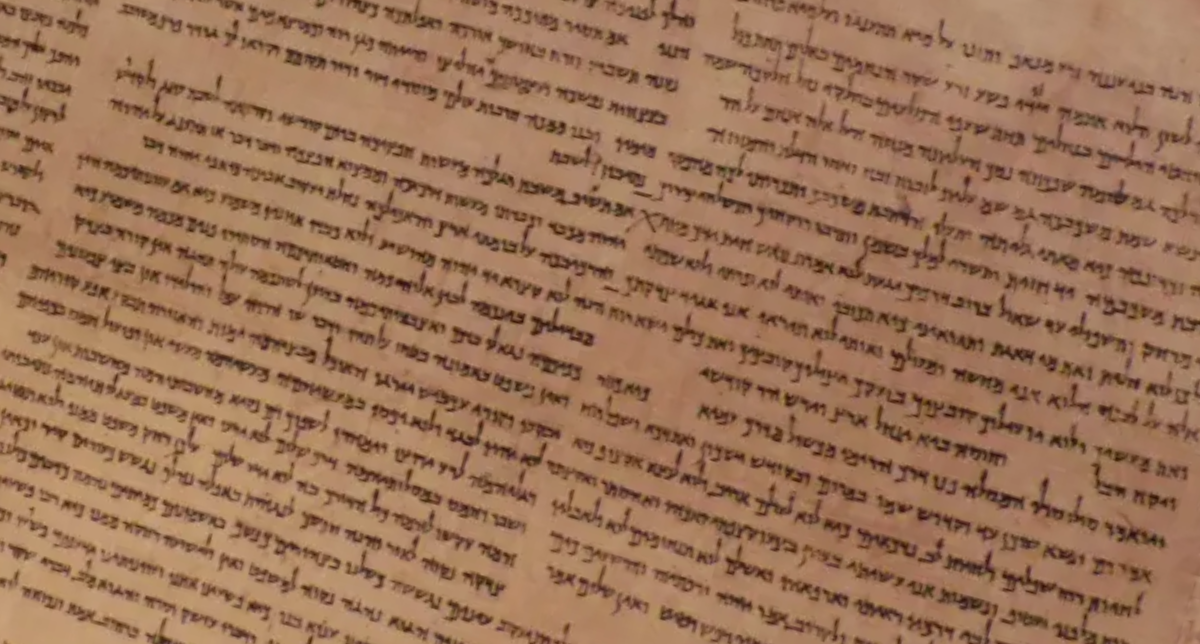
They did not. Read what His own countrymen said about Him and the picture gets bleak fast:
So here's an honest question. If you had lived in the first century and someone had pointed Him out in a crowd saying, "He's right there" — would you have believed them?
Probably not. As conflicting as it feels, you could not have picked Jesus out of a crowd.
For roughly the first 200 years of Christianity, depictions of Jesus were remarkably scarce. With one notable exception.
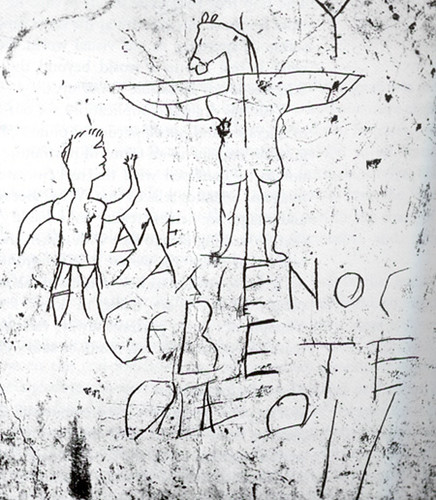
The earliest artwork on record pertaining to Christianity is Alexamenos' graffito, carved into plaster on a wall in Rome in the first century.
It depicts a man looking at a donkey-headed figure being crucified. The inscription reads, "Alexandro worshiping his god."
It was not a celebration. It was mockery.
In the first century, Christianity wasn't an official religion, and most Roman citizens regarded its practitioners with suspicion and contempt. The graffito was scratched out to make fun of a Christian named Alexandros by implying he worshiped a donkey-headed god. And the fact that his god is shown being crucified made it worse still.
Think about that. The oldest surviving image of Jesus is a piece of insulting street art.
Jesus was bare on that cross for all the world to see. No loincloth. No way to cover Himself with His hands, because His arms had already been nailed down.
Utterly humiliating. And utterly consistent with everything Isaiah said seven hundred years earlier.
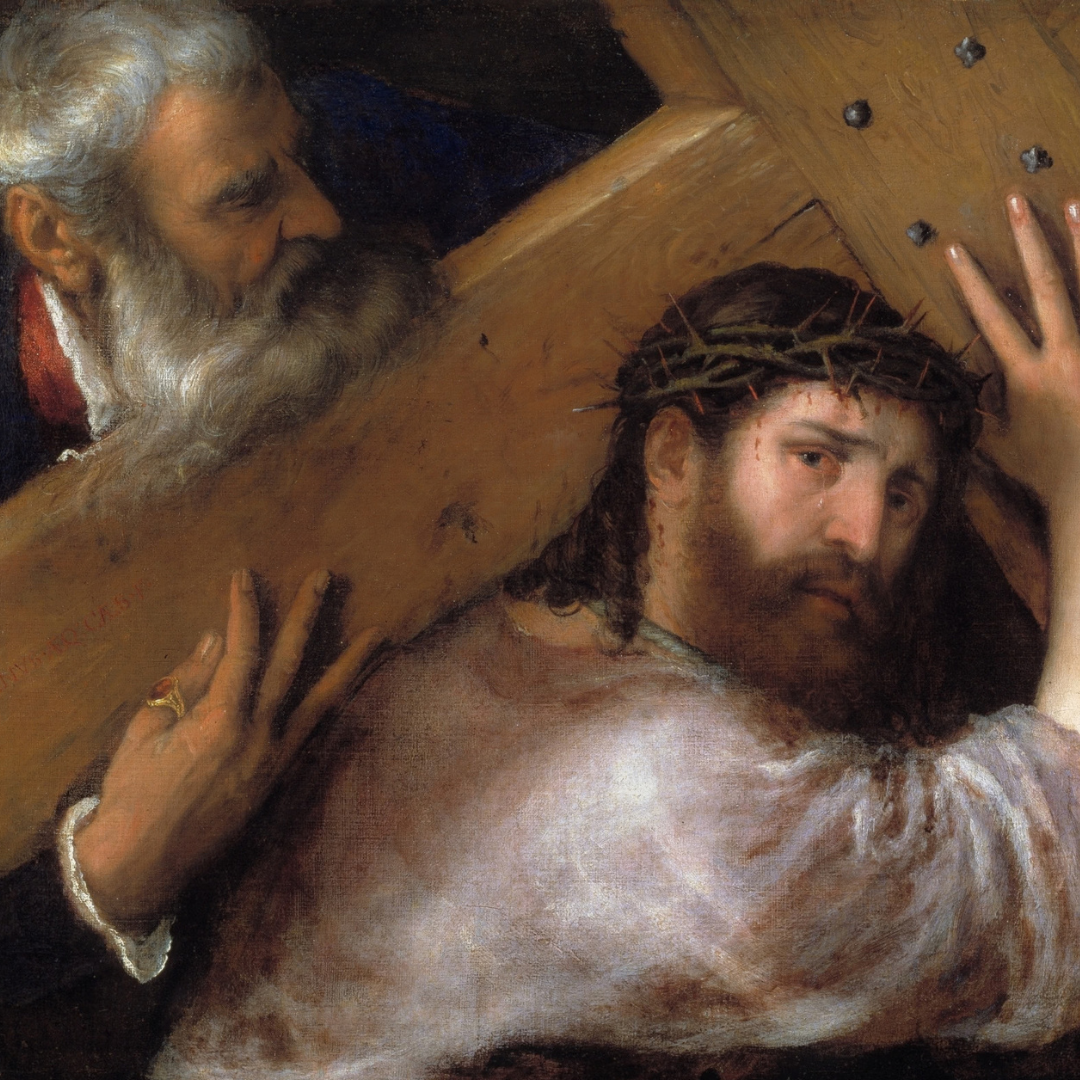
This is the question the silence was built to force on you.
Imagine commissioning four Renaissance masters with the same assignment: show us what you see when you look at Jesus, instead of merely telling us.
Michelangelo might hand you The Last Judgment arching over the Sistine Chapel's altar. Da Vinci, inventive as he was, might return with a blueprint. Titian, famous for emotional depth, would capture the human intensity and struggle. Raphael, known for harmony and grace, would emphasize compassion and mercy.
Four wildly different works. All of them true. And not one of them a police sketch.
That's exactly what happened:
Vantage point mattered, too. Picture a four-way intersection where a wreck has occurred — except instead of cars, it's grace and truth colliding head-on in the person of Jesus Christ.
Matthew stands on one corner, up close as one of the Twelve, very little obstructing his view. Mark is halfway down the block, close enough to be an eyewitness but needing Peter's help with particulars. Luke arrives afterward like an investigator, interviewing everyone who was there. And John stands in the middle of the intersection, closer to the wreckage than anybody — he was in the inner circle of three, and he leaned against Christ's breast at the Passover meal.
Four men. Four vantage points. One Savior. Not one physical description among them.
They were never withholding something from you. They were aiming you.
When I was a boy in Patton Place, my mother asked me one afternoon, in that beautiful long-winded southern drawl that sounded more like a lullaby than an accent, "What do you see?"
"Not much," I told her. "Except for the front yard."
"Now, George," she said, using up three syllables where one would do, "You must look closer. What else do you see?"
"I see our mailbox, a big tree, a squirrel."
Clearly, I was missing something right in front of my nose and had no idea what.
The sun was settling in for the night, its last rays fading but still coming through the window. Sensing my apprehension, she eased me off to the right and spun me back a half-circle to look at where I'd just been standing.
From that new vantage point, everything was different.
"Now then," she whispered. "What do you see?"
Thousands of shiny dust particles that had been floating there the entire time. They'd been glistening moments before and I simply couldn't see them. Now they lit up the whole foyer.
"Remember, Georgie," she said, basking in a point well made. "There's always more to see… but you must look for it."
She didn't hand me the answer. She moved me to where I could finally see it for myself.
That's precisely what the Gospel writers did with the face of Jesus. They didn't describe it, because describing it would have let you stop looking.

On Monday, November 1st, the Holy Spirit prodded me to visit my mother in the ICU before leading my early morning men's group. She had been non-communicative for a month.
We had stopped doubting what was coming six weeks earlier, when she kept asking an empty room, "Whose voice keeps calling my name? Who is that?" From that point on we gave that Person's voice a hundred times more credence than any lab result.
I hadn't prepared any last words. For all intents and purposes she was already gone.
Then I rounded the corner, peeled back the curtain, and her eyes locked onto mine. Not a glazed look. Not peering through me like glass. A gaze that connected.
Unrehearsed and straight from the hip, I blurted out, "Sandra, I can't wait to see you again at the last resurrection, okay? We will meet each other again then, okay?"
And I watched her head nod in hearty — though incredibly frail — agreement.
I don't believe in luck. But I walked out of that hospital saying over and over, "I'm the luckiest person in the world."
That evening, with family packed into her room, we sang the Doxology together. The nurse slipped in afterward to tell us, "The exact second you ended with 'Amen,' her heart monitor went flat."
Oh, how marvelously the tables turn.
It carried me right back to Patton Place — the sun settling in for the night, my mother spinning me around to look at where I'd just been standing, and everything appearing different from the new vantage point.
Which is precisely what heaven is. Faith becomes sight, and prayers become praise.
"Now then," I'd love to ask her. "Please tell me. What do you see?"
I suspect the answer would be one word, softly drawled: Unspeakable.
Until we get there, here's what we have: four separate paintings of the same Savior by four different men. It's like studying the back of a tapestry — you can make out bits and pieces, but your understanding stays capped until the finished product gets flipped around.
Paul said it perfectly: "For now we see in a mirror dimly, but then face to face; now I know in part, but then I will know fully just as I also have been fully known." (1 Corinthians 13:12)
So what will He look like?
Honestly, I don't know. The scars, perhaps. But whatever the complexion, the face, the eyes, the hair — I truly believe we will be awestricken the moment we're engulfed by His presence.
Unbridled love. Unfiltered.
And when we finally do see His face, I suspect we'll understand exactly why they never described it.


