


What Does It Mean to Take Up Your Cross and Follow Jesus?
October 12, 2026
Read More

Calling Jesus "the Son of God" does not mean He was created by God or ranks somewhere beneath Him. It means He shares the very nature, authority, and identity of God Himself. The title is Mark's favorite designation for Jesus — and Mark chose it deliberately, for a specific audience, for a specific reason.
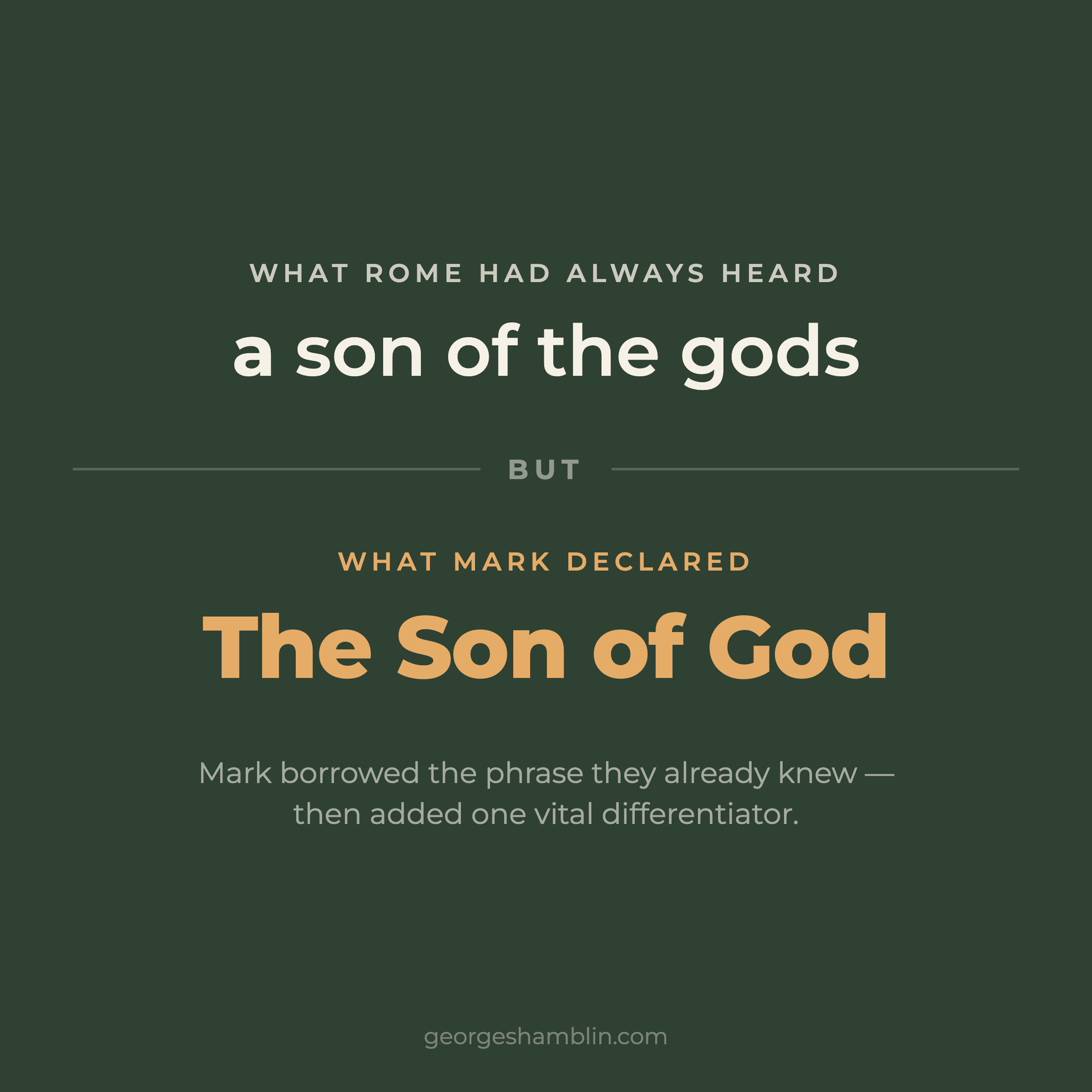
His readers were Greeks living in the Roman Empire. That empire was polytheistic, with an entire pantheon of gods and goddesses, and those people had heard about "sons of the gods" their whole lives.
So Mark borrowed the phrase they already knew. Not as a bait and switch, but as a lure to set the hook. And then he added one vital differentiator.
Jesus is not a son of the gods. He is The Son of God.
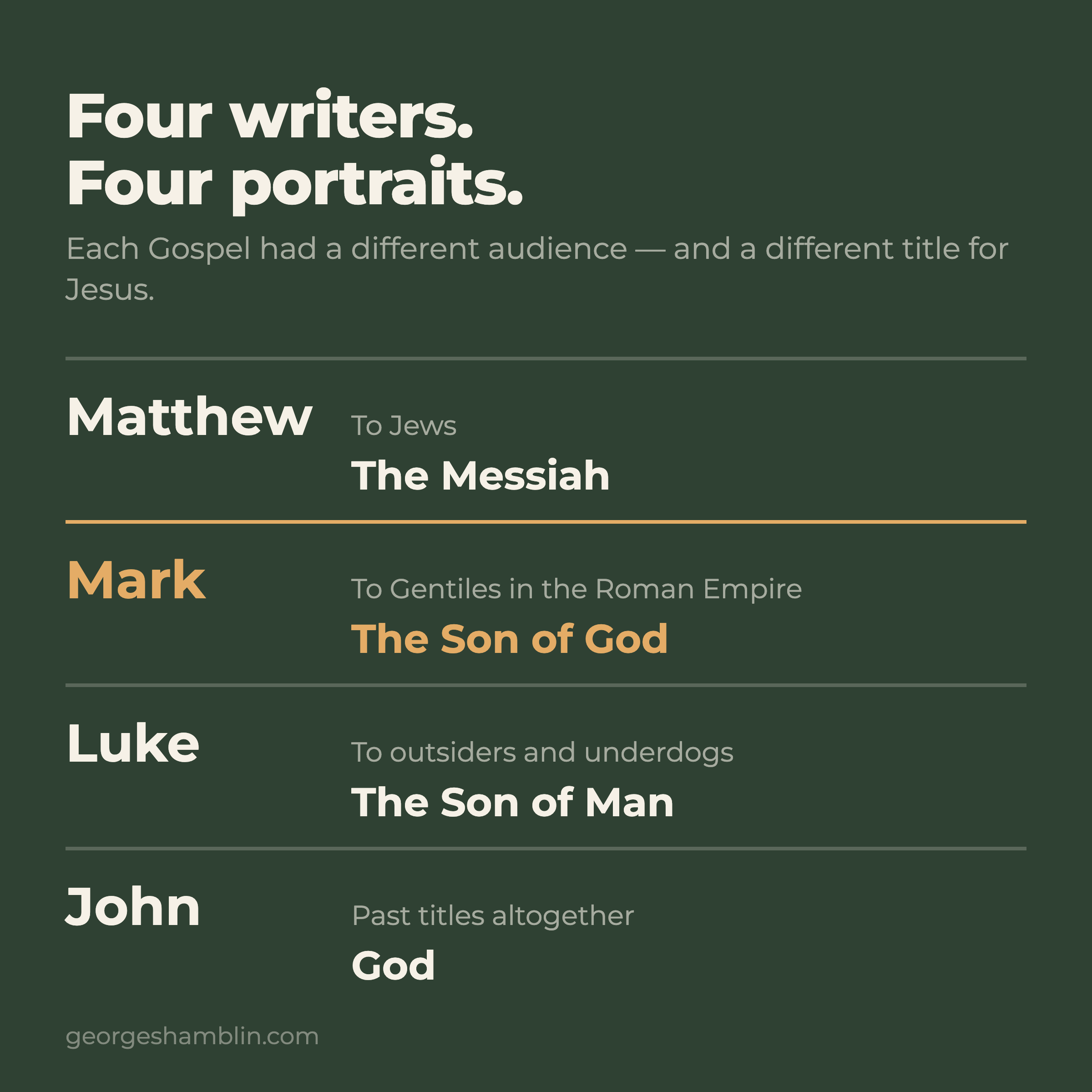
Because each Gospel writer had a different audience and a different portrait to paint.
How do we know Mark's audience was mostly non-Jewish? He tips his hand repeatedly.
He barely uses the Old Testament. The Torah was the lifeblood of Judaism, but it carried almost no weight beyond Israel's borders.
He also stops to explain customs that every Jew alive already understood. When the argument over ceremonial washing comes up in chapter 7, Mark has to pause and explain hand-washing, market purification, and the washing of cups and pitchers and copper pots. He even explains that the day before the Sabbath is called the preparation day.
Think of it this way. If two Americans are talking about Thanksgiving, neither one stops to explain turkey and dressing, the Lions, the Cowboys, or why we celebrate. It's all a given. But mention Thanksgiving to someone from another country and suddenly every piece of it needs unpacking.
That's Mark. He was explaining the givens, because to his readers, they weren't givens.
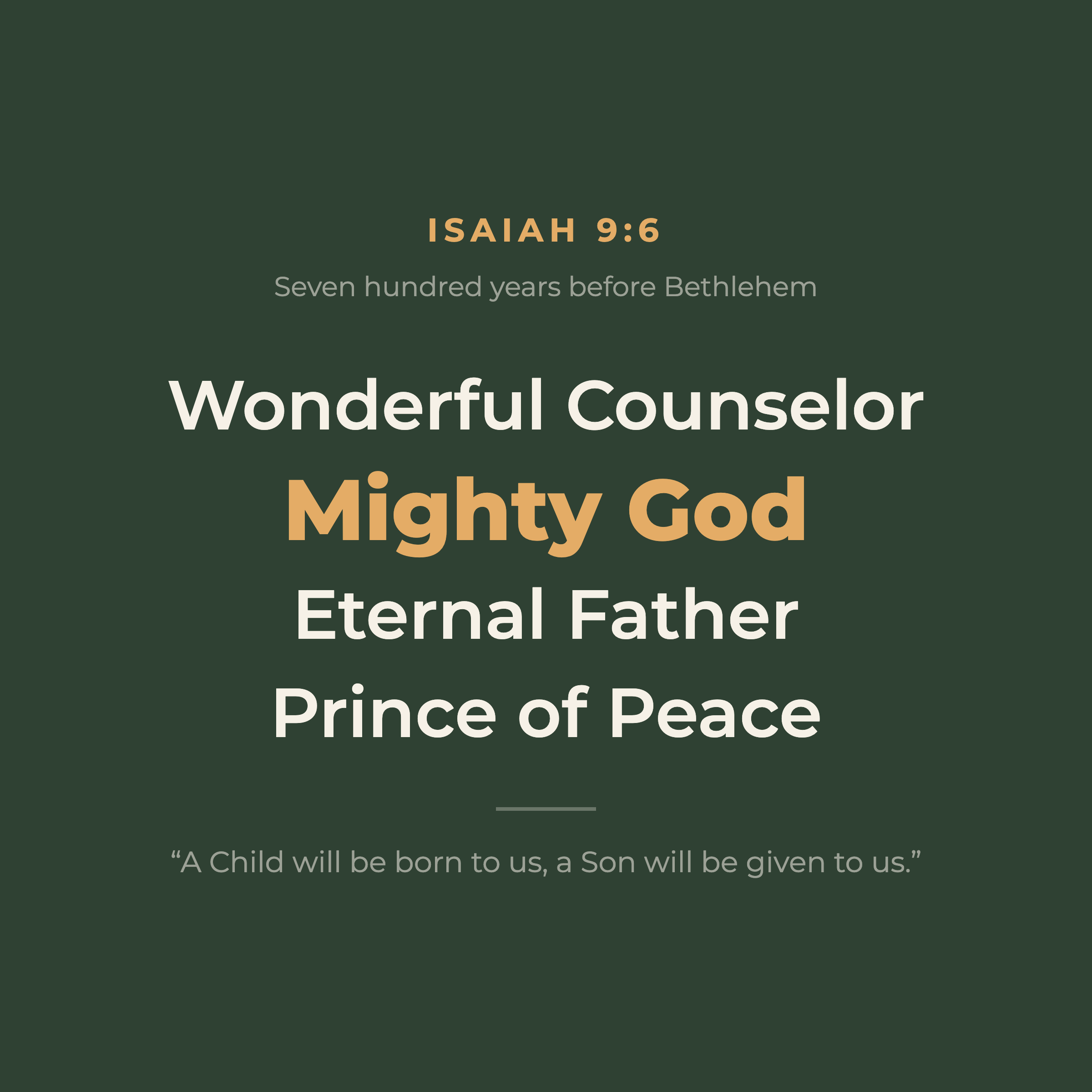
No, and this is where the Old Testament had already prepared the ground, 700 years before Bethlehem.
Isaiah wrote, "A Child will be born to us, a Son will be given to us; and the government will rest on His shoulders; and His Name will be called Wonderful Counselor, Mighty God, Eternal Father, Prince of Peace."
Now stop and consider how that landed. The Jews were emphatically monotheistic. One God. Try to imagine how terribly confusing it must have been for them to hear a little Child called "Mighty God" and "Eternal Father."
Ten thousand times in history a baby has become a king. Only once has a King become a baby.
Isaiah's Son is Mighty God. Not a lesser deity in a crowded pantheon. Not a demigod. The title carries divinity inside it.
And for Mark's Gentile readers, that changed something enormous. They weren't just being handed one more name for one more god. They could rest assured that an audience with the Ruler of all Creation was available to them.
To everyone. Not just to Israel.
Because Mark was smart enough to know that testimony is only as strong as the witness giving it.
Think about who was standing at the cross.
A centurion. A professional executioner. A man who had watched more people die than anyone in that crowd, and who had every reason in the world to be unimpressed.
He watched how Jesus died, and out of his mouth came a confession of faith.
That's Mark using a credible source — a Roman soldier, from the very empire that was doing the killing — to validate Christ. If you wanted an unbiased witness in the first century, you could hardly do better.
And here's the sobering part of Mark's picture. That confession comes at the end of a Gospel where almost nobody else got there. The crowds walked away. The religious leaders led the parade out. His own family said He was out of His mind. Peter denied ever knowing Him.
The man who finally said it out loud was the one holding the hammer.

Let me tell you a story I've never been able to shake.
There was a very wealthy man who shared a passion for collecting art with his son. Picassos and Van Goghs hung on the walls of the family estate. Then war engulfed the nation, the young man left to serve, and a few short weeks later a telegram arrived. His son had died.
Christmas came, and the old man faced it with nothing but anguish. Every masterpiece on his walls only reminded him that his boy wasn't coming home.
On Christmas morning, a knock. A soldier stood at the door with a large package. "I was a friend of your son. I was the one he was rescuing when he died. May I come in? I have something to show you."
The soldier was an artist. The paper fell away to reveal a portrait of the man's son — nothing the world would ever call the work of a genius, but the young man's face rendered in striking detail.
Overcome, the father hung it above the fireplace, pushing aside millions of dollars' worth of art. He spent that entire Christmas in his chair, just looking at it. It became his most prized possession, eclipsing every piece the museums of the world were clamoring for.
The following spring, he died. His will stipulated that the entire collection be auctioned on Christmas Day — the day he'd received the greatest gift of his life.
Collectors flew in from around the world. And the auctioneer opened with the painting that was on nobody's list. The portrait of the son.
"Who will open the bidding at $100?"
Silence.
Someone finally spoke up: "Who cares about that painting? It's just a picture of his son. Let's move on to the good stuff."
"No," said the auctioneer. "We have to sell this one first. Now — who will take the son?"
A neighbor offered ten dollars. "That's all I have. I knew the boy, so I'd like to have it."
Going once. Going twice. Gone. The gavel fell and the room cheered: "Now we can bid on the real treasures!"
Then the auctioneer announced the auction was over.
The room came unglued. Millions of dollars of art still sitting there — what do you mean it's over?
"It's very simple," he said. "According to the will of the father, whoever gets the son… gets it all."
That's what Mark is doing with this title. It's Jesus alone we must see and consider. Because of the Father's love, whoever gets the Son gets it all.
A few years back, CBS Evening News ran a story about a Handel and Haydn Society concert in Boston featuring some of the finest classical musicians in the country. But the most memorable moment of the night didn't come from the stage.
After the crescendo of Mozart's Masonic Funeral Music, somebody in the audience shouted, "Wow!"
That's not how one behaves at a classical concert, and the sound of it rang through the hall and through the whole classical music world.
It was a nine-year-old boy named Ronan, sitting there with his grandfather. Ronan was autistic and considered non-verbal. His family had been told he would never speak a word.
Beautiful music woke something dormant in that boy, and it came out as one syllable.
If Mark's account, which is far more exhilarating than Mozart, has stopped awakening wonder in your soul, be alarmed.
Our reaction to the Son of God ought to be the centurion's. In today's language, that's just one word.
Wow.
Does "Son of God" mean Jesus was created?
No. Isaiah's prophecy names the promised Son "Mighty God" and "Eternal Father" — the title carries full divinity within it. Mark's whole purpose in using it was to distinguish Jesus from the "sons of the gods" his Greek readers already knew about.
Which Gospel calls Jesus the Son of God most often?
Mark. He wrote primarily to Gentiles in the Roman Empire, and he anchored the title at the beginning of his Gospel, the middle, and the end.
Who was the first person to call Jesus the Son of God at the cross?
A Roman centurion — a professional executioner — who said, "Truly this man was the Son of God!" after watching Jesus die (Mark 15:39). Mark deliberately used an outside, credible witness to validate the claim.


